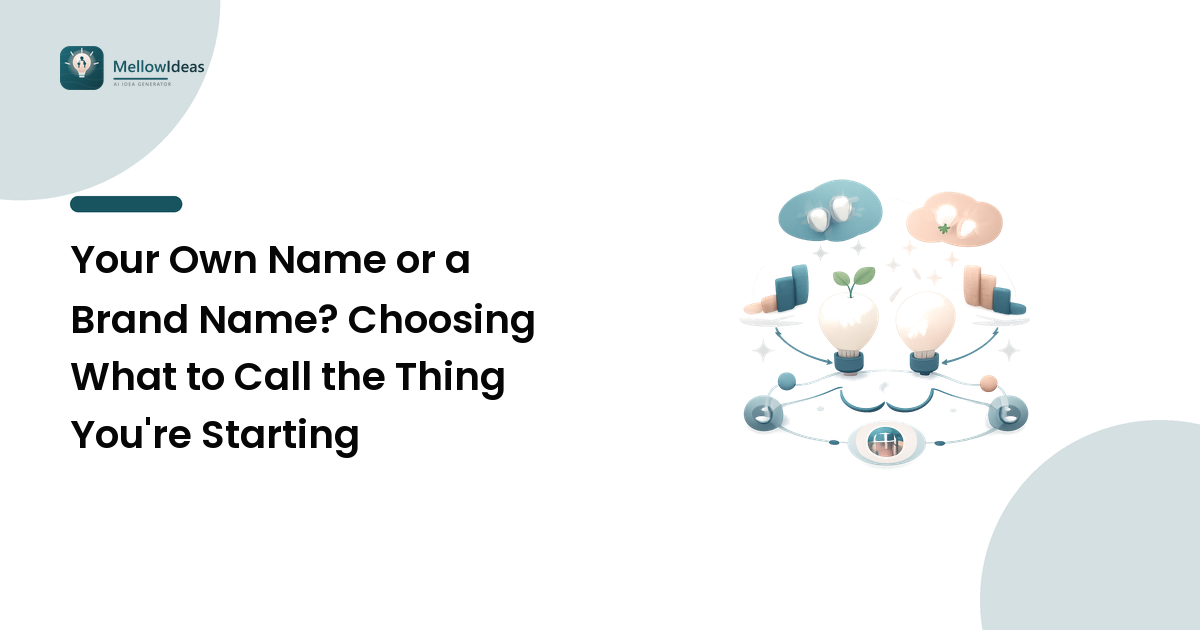
You're about to put something into the world — a service, a shop, a newsletter, a small studio — and you have to write a name on it. Two options are staring at you. Use your own name, the way accountants, architects, and photographers have always done. Or invent something separate, the way most products do.
The advice you'll find tends to be tribal. One camp says people buy from people, so put your face and your name on it. The other says a personal name traps you and you'll regret it the day you want to hire, sell, or change direction. Both are describing something real, and neither is a rule.
Here's the trade-off underneath the argument: your own name buys you borrowed trust straight away and quietly spends your future options. A brand name costs you attention at the start and buys you room later. Which one is the better deal depends less on your taste than on a handful of practical facts about what you're building.
What each option is really optimising for
A personal name is a shortcut to credibility. It signals a specific human is accountable for the work, which is exactly what someone hiring an editor, a coach, a joiner, or a photographer wants to know. There's nothing to explain, nothing to remember, and no gap between who they met and what's on the invoice. It also can't be a bad name, in the way an invented one can be — nobody thinks your surname is trying too hard.
A brand name is a container. It's a thing that can hold more than you: employees, a second service line, a product you haven't thought of, eventually an owner who isn't you. It starts as an empty word that means nothing to anyone, and every piece of work you do puts a little meaning into it. That's slow, and it's the whole point — an asset you can build is an asset you can hand over.
Almost every genuine argument between the two camps is really an argument about time horizon. The personal name wins the first year. The brand name wins the years where you want to be somewhere other than the middle of everything.
Seven questions that settle it faster than debate
Answer these honestly on paper. They decide it more reliably than which option sounds nicer out loud.
1. Is the deliverable you, or the output? If the client is buying your judgement, your eye, or your hands — consulting, therapy, portrait photography, ghostwriting — the personal name is telling the truth. If they're buying a thing that would be identical made by someone else, your name is decoration.
2. Could you ever want to sell it? A business named after you is harder to sell and harder to leave. Not impossible, but the buyer is purchasing a name that points at a person who's walking away. If the exit is even a vague someday, that's a point for the brand.
3. Will other people do the work? The first time a client asks "so will you be doing it?" and the answer is no, an eponymous name starts working against you. A brand lets a team be a team without anyone feeling downgraded.
4. How wide could the scope go? Think about the widest plausible version of this in five years. A personal name is infinitely flexible in scope — it means whatever you do — which is either its best feature or its worst, depending on whether you want to be findable for one thing.
5. Is your name easy to say, spell, and find? Test it out loud on a phone call. Then search it plainly and see what's already there — a well-known person with your name, or five hundred other people with it, changes the maths. This is the same searchability problem covered in how to choose a domain name, just with a name you didn't get to pick.
6. How much do you want your work and your identity fused? A personal name means your business is permanently searchable alongside you. For some people that's the point. For others — anyone who values a boundary between work and private life, or who might want to start something unrelated later — it's a cost they only notice years in.
7. Are you testing or committing? If you genuinely don't know what this becomes yet, your own name is the low-commitment option. You can trade under it, learn what you're actually selling, and name the real thing once you know what it is.
Where each one clearly wins
Use your own name when: you are the service, the relationship is direct and personal, you work in a field where eponymous practices are normal and reassuring, you're testing an idea, or the thing you're best known for is already your name.
Build a brand name when: you're selling a product, you plan to hire, several people will deliver the work, you'd like to sell or step back one day, your field's customers are buying a company rather than a person, or you want to be findable for a category rather than for yourself.
Genuinely close calls exist, and they're usually creators and small studios who are both the face and the business. That's where the middle options earn their keep.
The middle options people forget
The two camps present a binary, but most working answers sit between them.
- Name plus descriptor. "Ellis Bookkeeping," "Farid Studio." Keeps the human signal, adds a category, and reads like a company rather than a person's inbox.
- A brand with a visible human. The business has its own name; you're openly the founder, on the about page and in the writing. This gets most of the trust benefit without welding the two together.
- Personal name as umbrella, brands underneath. Common for creators: your name is the body of work, and individual products or courses get their own names.
- A working name. Use your own name while you figure out what this is, and name the real thing when the shape is clear. Renaming later is genuinely annoying, but it's cheaper than committing to the wrong container early.
Two things both camps get wrong
"A personal name doesn't scale." Plenty of large, long-lived firms are named after people who died a century ago. It's not the ceiling people claim — it's a preference for a certain kind of business, one where a name means a standard rather than a person.
"A brand name is more professional." A vague invented word with an awkward spelling is not more professional than a plain surname. Made-up names have to earn meaning; until they do, they're just harder to remember. The failure mode of invented naming is covered in the wider method in how to name a business.
A worked example you can copy
Priya does freelance data work for small charities. Her shortlist: Priya Raman Data and Kestrel Analytics.
She runs the seven questions. The deliverable is largely her judgement (personal). She can't imagine selling it (personal). She'd like one subcontractor eventually, not a team (mild brand). Scope might widen from reporting into training (neutral). Her name is easy to say and rare enough to find (personal). She's comfortable being publicly attached to her work (personal). She's committing, not testing (neutral).
Six pointers, mostly personal. She picks Priya Raman Data — the descriptor does the category work, and if the subcontractor ever becomes three people, "Raman Data" is a short step away that keeps everything she's built.
Notice what decided it: not which sounded better, but what the business actually is.
Before you commit to either
Whichever way you go, the same checks apply. Availability of domains and social handles changes constantly, and trademark law is jurisdiction-specific — check the relevant registry and, for anything you'll invest in seriously, talk to a trademark professional before you print anything. Nobody on the internet, including us, can tell you a name is legally safe to use. The practical sequence is in how to check if a business name is available.
One extra check for personal names: search your own name the way a stranger would, and see what else shows up. You're not obliged to compete with a namesake, but it's better to know before the business cards.
FAQ
Can I change from my own name to a brand name later? Yes, and people do it regularly. It costs you some accumulated recognition and a tedious admin week. It's a real cost, not a catastrophe — and usually smaller than the cost of committing to a name that doesn't fit what you're building.
Does a personal name hurt search visibility? Not inherently, but it makes you findable for your name rather than your category. Descriptors, service pages, and clear writing do the category work either way.
Is a brand name better if I want to look bigger than I am? Looking bigger than you are is a short-lived advantage and an awkward conversation when it unravels. Choose the name that fits what this becomes, not the one that inflates what it is now.
What if I like an invented name but can't get the matching domain? Very common, and not automatically fatal — a modified domain can work fine. It's a signal worth weighing rather than a veto, and it's worth checking before you fall in love with the word.
Still staring at a blank field? Mellow Ideas builds friendly generators for exactly this moment — get business name starting points at Mellow Ideas. They hand you a batch of options to react to; the judgement about which one fits your actual business stays with you.