You found the name. It sounds right, your friend liked it, and the .com is sitting there unregistered for the price of a sandwich. It is very tempting to call that "available" and start ordering business cards.
Here is the calm version: "available" isn't one thing. It's at least six separate layers, and a name can pass every easy one and still fail the layer that matters most. A free domain tells you nobody bought that web address. It tells you nothing about whether another company already trades under that name or holds a registered trademark for it.
This guide walks through each layer and what to do when one says no. One thing we'll be straight about throughout: this describes how the checks work — it isn't legal advice. Name rights are jurisdiction-specific and depend on your industry and how you use the name. Nothing here, and no generator including ours, can tell you a name is legally safe. For anything you're about to invest real money in, confirm with the relevant official registry and a qualified trademark attorney.
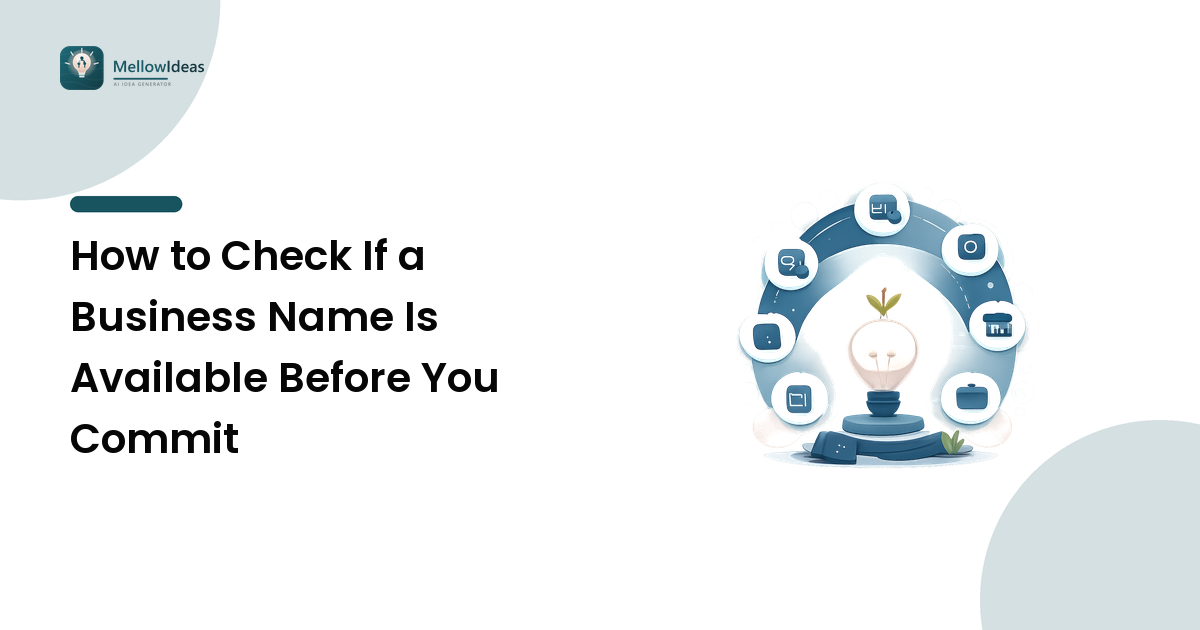
The six layers of "available"
Run these as separate questions. A yes in one is not a yes in another.
1. The domain
The easiest check and the least meaningful. A registrar search tells you whether that exact web address is unregistered right now. That's it. Plenty of names with a free .com are already in heavy use by a business trading under a different domain — and plenty of usable names have a taken .com and a clean everything else.
Treat the domain as a convenience question, not a rights question. If you're weighing extensions and variants, our guide to choosing a domain name covers the trade-offs.
2. Social handles
Check the platforms you'll genuinely use, not all of them. Handles are first-come, first-served, and someone's long-abandoned account can sit on your ideal username indefinitely. Passing here is looser than people assume: a small suffix ("getname", "namehq") is an inconvenience rather than a failure. But if the handle belongs to an active account in your industry, that's not a handle problem — it's a clash problem, and it belongs in layer six.
3. App stores and marketplaces
If your business will ever live inside an app store, a plugin directory, or a marketplace with its own seller names, search there too. These directories have their own naming rules and duplicate-listing policies, entirely separate from domain and trademark systems. People routinely skip this and discover the conflict at submission time — the most expensive moment to find out.
4. Company and business registration
Here "available" starts to mean something official. Most jurisdictions have a register of company or business names — a national companies register, a state or provincial filing office, a local trade-name register, or some combination — and many let you search it for free.
Passing means something narrow but real: usually that no entity is already registered under that exact or confusingly similar name in that jurisdiction, so your filing is likely to be accepted. What it does not mean is that you own the name or are clear of trademark issues. Company registration and trademark rights are different systems that don't automatically talk to each other. Which register applies to you, and what "confusingly similar" means there, varies by country — check the rules of the registry you'll actually file with.
5. Trademark registers
This is the layer that can genuinely stop you. Most countries have a searchable trademark register — a national office, or a regional one covering several countries. You search for marks identical or similar to your candidate within the goods and services classes relevant to your business.
Two things make this harder than it looks. The test isn't "is it identical"; it's closer to "would an ordinary customer be confused", which sweeps in similar spellings, sounds, and meanings. And it's class-specific: the same word can coexist peacefully across unrelated industries and clash badly within one.
So a register search by a non-lawyer catches obvious disasters early and is genuinely not sufficient for a final answer. If anything close turns up in a related class, that's your cue to get a professional opinion rather than reason your way around it.
6. Common-law and "already in use"
The layer with no search box. In some jurisdictions, a business using a name in commerce can hold rights in it without registering anything. And even where that isn't the case, an established competitor using your name is a practical problem regardless of who technically holds what.
The check is manual: search the name plainly and with your industry words attached, and look through the directories your customers use. You're looking for anyone actively trading under it, especially near your category or region.
Why a free domain doesn't mean a free name
Worth its own heading, because it's the most common misunderstanding at this stage. Domains are an addressing system. Trademarks are a rights system. Company registers are an administrative system. Built separately, for different purposes, and they do not check each other. Buying a domain no more grants you the name than buying a street number grants you the street.
The practical consequence: buy the domain if you like, but don't announce the name, print anything, or build brand assets until the deeper layers are checked. A domain is cheap enough to lose. A rebrand six months in isn't.
Red flags that should quietly retire a candidate
Not every problem is fatal, but some findings mean the calm move is to let the name go:
- A registered trademark that's identical or near-identical in your industry class. No creative workarounds.
- An active, established business in your category using the name — even a small one, even in a country you might eventually enter.
- The name is a slight misspelling of a well-known brand. Not a clever loophole; the exact scenario the rules exist for.
- Every version of the name is taken everywhere. Sometimes that means the word is simply over-farmed.
- It means something unfortunate in another language you'll trade in, or the search results are dominated by something you'd rather not sit beside.
None of these require a lawyer to spot. That's the point of running the cheap checks first.
The order that saves the most time
Cheapest first, so doomed candidates die early:
- Plain search for the name, and the name plus your industry. Thirty seconds; kills more candidates than anything else.
- Domain and handle scan. Note the results; don't buy yet.
- Company or business register search in the jurisdiction you'll trade in.
- Trademark register search in the relevant classes.
- Professional check on your top one or two, if real money is going into the brand.
Only after step three or four is it worth registering the domain, and only after step five is it worth ordering anything printed.
Shortlist so you don't fall in love
The reason clearance feels devastating is almost never the clash itself. It's that people run the checks on one name they've already decided on.
Do it the other way round. Carry five candidates through, and don't rank them until after the cheap checks. Names die at this stage constantly — that's the system working, not bad luck. Five going in usually leaves two or three standing, and choosing between survivors is a pleasant afternoon instead of a crisis. If your list is thin, our step-by-step naming guide walks the shortlist method, and the naming styles roundup is decent raw material.
One more calm note: availability moves. Handles get abandoned, domains expire, registrations lapse. Re-check before you commit, not just once at the start.
FAQ
How do I know if a business name is already taken? Check the layers separately: search the name plainly and with your industry words, search your jurisdiction's company or business register, search the relevant trademark register in your goods and services classes, and check the platforms and app stores you'll use. Each answers a different question.
Does buying the domain protect my business name? No. A domain reserves a web address; it doesn't grant rights in the name. Domains, company registers, and trademark registers are separate systems that don't check each other.
Is a free trademark search enough? It's enough to catch obvious conflicts early, which is genuinely valuable. It isn't enough for a final decision, because the test involves similar-sounding and similar-meaning marks across related classes and varies by jurisdiction. Before investing real money in a name, have a qualified trademark attorney review it.
What if my name is available in one country but not another? Normal — these systems are national or regional. Check where you'll trade now, and think about where you might trade later. If a conflict exists in a market you plan to enter, factor it in before you commit rather than after.
Ready for a fresh shortlist?
Losing a name to a clash is a normal part of naming, not a sign you're bad at it. What makes it painless is having other candidates ready. When your list needs refilling, generate business name ideas at Mellow Ideas for a batch of friendly starting points. They're starting points, not cleared names — every check above still applies to each of them.