You used to bounce back after a good night's sleep and a quiet weekend. Lately, neither helps. You wake up already drained, the work you once cared about feels pointless, and you snap at people who did nothing wrong. A holiday sounds nice, but part of you suspects it would only delay the feeling. So you keep typing the same question into your phone: am I burned out, or just tired?
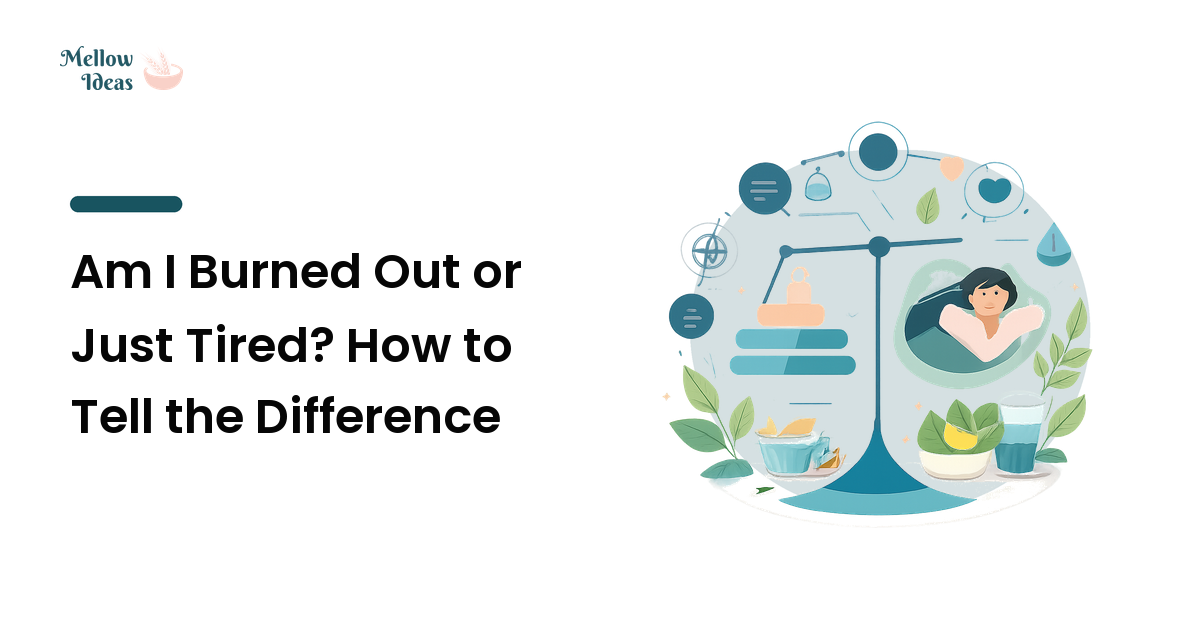
The takeaway up front: ordinary tiredness lifts with rest; burnout does not. Burnout is what happens when chronic, unrelenting stress outlasts your ability to recover from it — its hallmark is that the usual fixes stop working, and a weekend off leaves you just as hollow on Monday. Telling the two apart matters, because tiredness needs rest, while burnout needs you to change something about the load itself.
A quick, honest note first: this is general wellbeing guidance, not medical advice. Burnout can overlap with — and sometimes mask — real conditions, including depression and thyroid or other physical issues. We cover when to seek a professional near the end, so please do not skip it.
Burnout vs. tired vs. stressed: the core distinction
These three words get used interchangeably, but they describe different things — and the difference is the whole point.
Tiredness is a fuel problem. You are short on sleep, your body wants rest — and crucially, rest works. If a quiet weekend genuinely refills your tank, what you have is tiredness, not burnout. Much everyday exhaustion is exactly this, and it responds to the ordinary energy fixes in our guide to why you might feel tired all the time.
Stress is a response to pressure — usually with a finish line. A deadline, a hard month, a big move: stress ramps you up to meet a demand, then winds back down once it passes. In normal doses it is uncomfortable but temporary.
Burnout is what stress becomes when it never lets up and recovery never comes. It is not a single hard week; it is the slow erosion of months of relentless demand without enough relief. Where stress over-engages you, burnout disengages you — you stop caring, go numb, run on empty. That shift from "wired and overwhelmed" to "flat and detached" is one of the clearest tells that you have crossed from stress into burnout.
The three signs that point to burnout
Burnout is widely described as having three recognizable dimensions. Ordinary tiredness usually involves only the first; true burnout shows all three together.
1. Exhaustion that rest doesn't fix
This is more than sleepy. It is a deep, draining fatigue — physical, emotional, and mental — that a good night's sleep barely touches; you wake unrefreshed and feel depleted out of all proportion to what you have actually done. The defining feature is not the tiredness but its stubbornness: it persists through the very rest that should fix it.
2. Cynicism and detachment
This is the sign people most often miss in themselves, and the one that most distinguishes burnout from simple tiredness. Work you once found meaningful starts to feel pointless or irritating; you go through the motions, feel numb or distant from people, and grow cynical about things you used to care about. This distancing is the mind protecting itself from a load it can no longer carry — and it rarely shows up from one tired week.
3. Feeling ineffective, no matter the effort
Burnout chips away at your sense of competence. Routine tasks feel hard, you doubt your abilities and struggle to concentrate, and nothing you do feels like enough. The cruel twist is that as exhaustion grows your actual capacity drops too, so the harder you push, the more you confirm the fear of falling short.
If you mostly recognize the first point and rest still helps, you are probably tired. If all three ring true — especially the cynicism and detachment — that pattern points toward burnout. Here both usual instincts fail: pushing harder pours more demand onto an already overdrawn account, while a week off only helps until you return to the same conditions. Burnout is fixed by changing the conditions that keep emptying you.
What actually helps you recover
Recovery is rarely one dramatic change. It is a series of small, deliberate ones that lower the demand and rebuild your reserves — not quitting your life, and not "just relaxing."
- Name it honestly. Admitting "I am running on empty and this isn't sustainable" is not weakness — it is the first accurate read of the situation, and accuracy is where change starts.
- Find one thing to subtract. You cannot recover while the load stays at full; a single commitment dropped, delegated, or declined creates breathing room that more sleep alone cannot.
- Protect real recovery, not just collapse. Scrolling on the sofa is stimulation, not rest. Genuine recovery looks like a screen-free walk, time in daylight, or quiet that asks nothing of you — defend a small pocket daily.
- Reclaim a sense of control. Burnout grows where demands are high and control is low, so small reclaimed choices — your start time, a boundary on after-hours messages — push back against the helplessness that feeds it.
- Reconnect with people and meaning. Detachment is a core symptom, so gently reversing it helps: a real conversation, a moment of support, remembering why your work mattered to you. Recovery is rarely fast or linear, so be patient — you are refilling reserves that took months to drain.
When to talk to a professional
Burnout is not always only burnout — and it is not a diagnosis to make on yourself. Please reach out to a doctor or mental health professional if your exhaustion and low mood have lasted weeks despite real changes; if you feel persistently hopeless, empty, or unable to enjoy anything; if you are struggling to function or sleeping and eating very differently than usual; or if you are leaning on alcohol or other substances to cope. Burnout, depression, anxiety, and conditions like thyroid problems can look alike and overlap, and a professional can tell them apart. Asking for help is sensible, not an overreaction. And if you ever have thoughts of harming yourself, treat it as urgent and contact a local crisis line or emergency services right away.
FAQ
How do I know if I'm burned out or just tired?
The simplest test is whether rest works. Ordinary tiredness lifts after good sleep and a real day off; burnout does not — you return just as drained. Tiredness is mainly physical, while burnout adds two things rest can't fix: cynicism or detachment from things you used to care about, and a sense of being ineffective no matter how hard you try.
What are the first signs of burnout?
Often it starts with exhaustion that sleep no longer cures, followed by a creeping detachment — work begins to feel pointless or irritating, and you go numb or cynical about things that once mattered, with a drop in confidence and focus close behind.
Is burnout the same as depression?
No, though they share symptoms like exhaustion, low mood, and detachment, and can overlap. Burnout is typically tied to chronic stress in a specific area such as work, while depression is broader and pervades most of life. Because they look alike, a professional is the right person to tell them apart.
How long does it take to recover from burnout?
There is no fixed timeline — it depends on how long the stress built up and how much you can change. Recovery tends to be gradual and non-linear rather than a quick rebound, often unfolding over weeks to months as you lower the demands and rebuild your reserves.
The one thing to remember
If you take one idea from this guide, make it this: tiredness asks for rest, but burnout asks you to change the load. When a weekend off no longer restores you, when caring feels impossible, and when effort stops feeling effective, that is not laziness — it is a signal that the demands on you have outrun your capacity to recover. The way back is not to grit your way deeper, but to name it honestly, subtract where you can, protect real rest, and reach for support before you hit empty. And if the heaviness lingers despite those calm changes, that is exactly when a conversation with a professional is the wise next step. Explore more calm, practical wellbeing guides at Mellow Ideas.