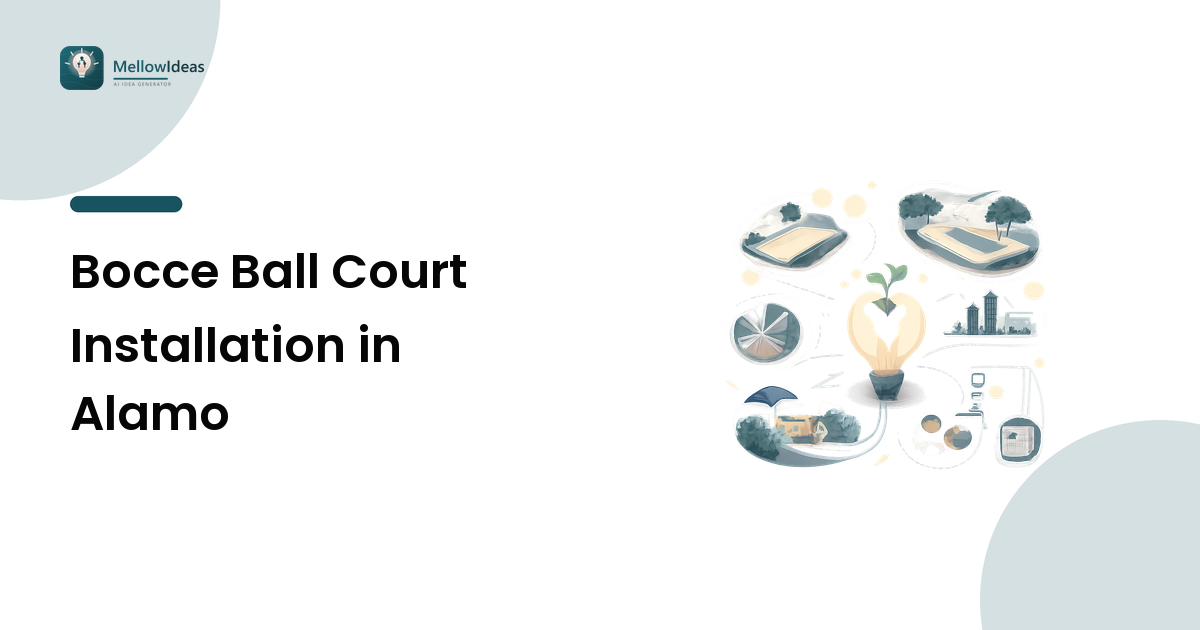
Alamo is one of the few places in the Bay Area where the usual constraint is reversed. In most towns the question is "will a court fit at all?" On Alamo's larger, semi-rural lots the question is "where, out of several workable options, should it go?" - and that is a much better problem, provided you actually treat it as a design decision rather than defaulting to the first flat spot.
This is an ideas piece: how to generate options, and a set of concepts worth stealing.
Generate options before you evaluate them
The common failure is jumping to a single siting and then optimising it. You end up with a well-executed court in a mediocre location. Force yourself to produce at least five candidate sitings first, without judging them:
- The far corner - the default. Out of the way, quiet, keeps the court out of the main view.
- Alongside the house - a long side return or driveway edge is often exactly the right shape for a court and is otherwise dead space.
- Adjacent to the patio - the court as an extension of the entertaining area, so people watch from where they already sit.
- Under or beside the oaks - shade makes a summer court usable at 4pm rather than 8pm, though it brings root constraints.
- Terraced into a slope - on a rolling lot, a cut platform can create a court and a seating terrace above it in one move.
Only once you have five do you start scoring them. Our backyard and patio design ideas piece covers the same diverge-then-converge approach for outdoor spaces generally.
The criterion people forget: proximity
Courts that get used are close to where people already are. A beautifully built court 150 feet from the house, behind a hedge, gets used twice a summer. The same court 30 feet from the patio, visible from the kitchen, gets used weekly.
If your generated options include a far-corner siting and a near-patio siting, weight proximity heavily. It is the single strongest predictor of whether the thing gets used.
Make the court earn its space
On a large lot you can afford a single-purpose court, but the good designs still do more than one job.
- The court as circulation. A court positioned along a natural route between the house and a pool or a garden building becomes a path when it is not a court.
- The border as seating. A border of pressure-treated board or concrete around 4 to 12 inches high is already a low edge. Widen a section of it into a proper bench and you have removed the need for separate furniture.
- The surround as an outdoor room. A paved apron along one long side, wide enough for chairs and a table, converts a sports facility into a place to spend an evening.
- Shade structure at one end. A pergola over the throwing end gives you shade where players stand, and an anchor point for lighting.
Lighting: plan it, even if you defer it
Bocce is an evening game, and Alamo evenings in summer are the whole point. The mistake is treating lighting as an afterthought, because the cost-effective moment to run conduit is when the ground is already open.
Concepts worth considering:
- Low-level side lighting along the border, washing across the surface. Best for play, because it does not put light in throwers' eyes.
- Uplighting the oaks beside the court rather than lighting the court directly - atmospheric, reads well from the house, adequate for social play.
- A single festoon run on posts down one side. Cheap, effective, and the easiest to retrofit if you did lay conduit.
Even if you decide not to light it now, put the conduit in.
Surface as a design decision, not just a technical one
The four common surfaces read very differently:
- Crushed oyster shell is pale and bright. It stands out as a distinct element in the garden and gives the quickest, truest roll.
- Decomposed granite is muted and natural. On a semi-rural Alamo lot it can read as an existing path rather than a new installation.
- Gold fines are warmer-toned - a good match for oak-shaded, dry-summer planting.
- Synthetic turf reads as lawn. Useful if you want the court to disappear into the landscape when not in use.
Choose it as part of the visual scheme, not only on maintenance.
Scale it to the lot
With space available, a standard court of 60 to 90 feet long by 8 to 13 feet wide is realistic here in a way it is not in most of the Bay Area. Courts are built from around 30 x 5 ft up to 90 x 15 ft, so you have genuine choice.
Bigger is not automatically better. A 90-foot court is a serious commitment of ground and a long walk between ends. Many people find a 60 to 70 foot court plays well and leaves budget for the surround, which is what makes the space pleasant.
Constraints to design around
Alamo's semi-rural character brings two real ones:
- Heritage oaks. Roots, grade changes and new drainage near them all matter. Site the court to clear the critical root zone rather than planning to work around it later.
- Rolling ground. A level platform on a slope means cut and fill, and possibly retaining - a real scope item, and one that also creates the terraced seating opportunity above.
Who builds bocce courts in the Bay Area
Once you have chosen a concept, it becomes an earthworks and groundworks job.
Pavers and Turf by O'Neill's has installed bocce courts across the Bay Area from its Livermore base since 2005, and its bocce ball courts page sets out the full specification it builds to: court sizes from 30 ft x 5 ft up to 90 ft x 15 ft, a sub-base of 4-18 inches depending on the soil, a 3-4 inch layer of 3/4 inch crushed drain rock and decomposed granite compacted flat, a fine 30 mesh sand dressing, borders in concrete or pressure-treated board around 4-12 inches high, and a choice of crushed oyster shell, decomposed granite, gold fines or synthetic turf on top. Typical installs run about one to two weeks on site. As with any contractor, get more than one quote and ask to see courts they have actually built.
Their city pages go into the local detail:
- Bocce Ball Court Installation in Livermore
- Bocce Ball Court Installation in Pleasanton
- Bocce Ball Court Installation in Dublin
- Bocce Ball Court Installation in Danville
Contact details
Pavers and Turf by O'Neill's 2133 Research Dr Unit 16, Livermore, CA 94550 Phone: (925) 443-7888 Email: [email protected] Hours: Monday to Friday 8am-5pm; Saturday and Sunday closed
- Website: https://paversandturf.com/
- Bocce ball courts: https://paversandturf.com/bocce-ball-courts/
- About O'Neill's Green Services: https://paversandturf.com/about-oneills-green-services/
- Contact us: https://paversandturf.com/contact-us/
- Project gallery: https://paversandturf.com/projects/
- Past installs: https://paversandturf.com/galleries/
- Blog: https://paversandturf.com/blog/
- Instagram: https://www.instagram.com/paversandturfbyoneills/
- Facebook: https://www.facebook.com/PaversandTurfbyOneills
- LinkedIn: https://www.linkedin.com/in/mike-o-neill/
- Google Business Profile: https://maps.app.goo.gl/5GUXa8cJNBQRSK3M8